The A2 Milk Company Faces Significant Share Price Volatility Following Voluntary US Product Recall
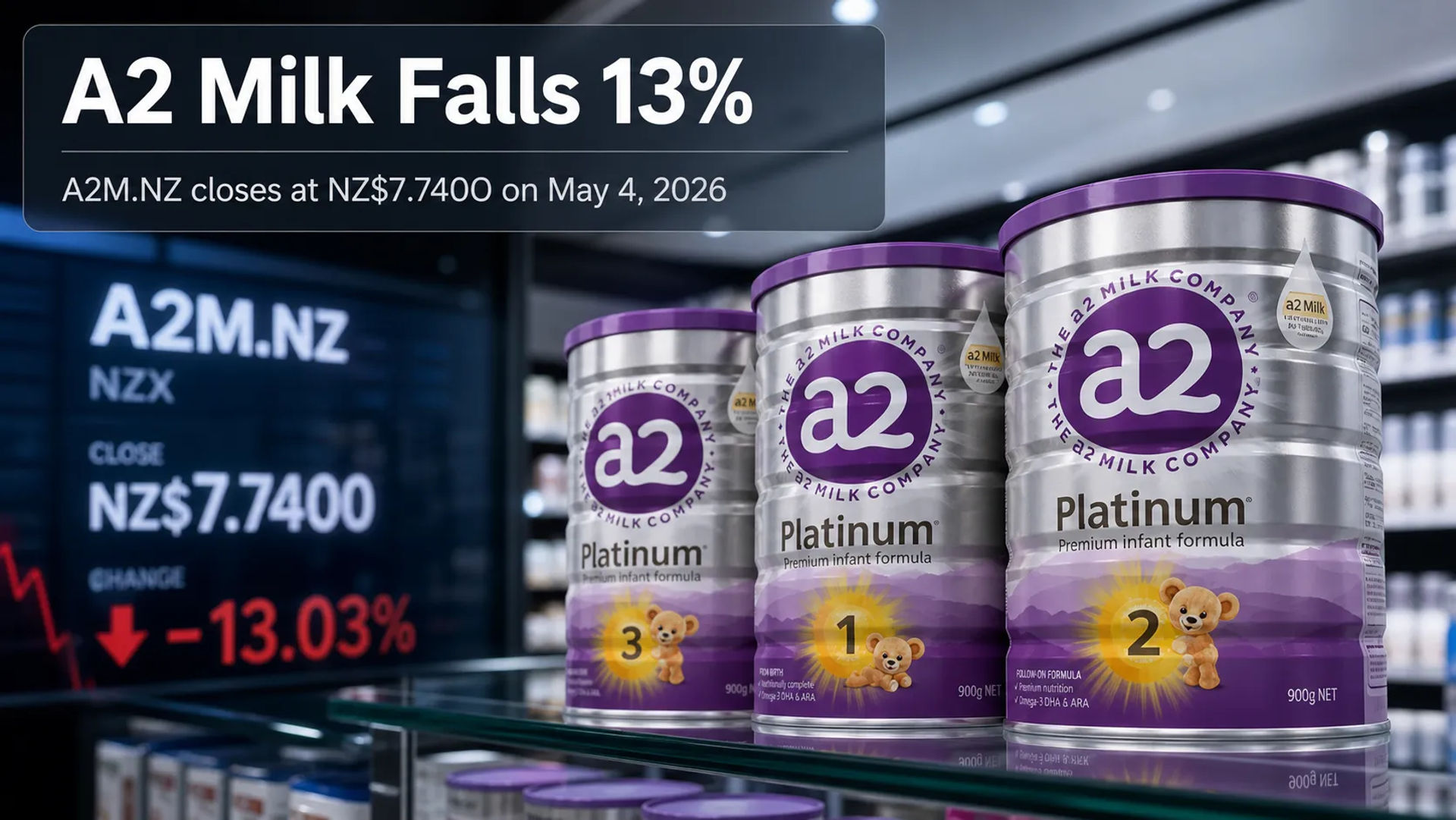
The A2 Milk Company (A2M.NZ) experienced a sharp contraction in market valuation on Monday, 4 May 2026, as investors reacted to a voluntary product recall in the United States. The New Zealand-based nutritional dairy specialist, which focuses on products containing only the A2 beta-casein protein, saw its share price close at NZ$7.7400, marking a significant daily decline of 13.03%. This downward pressure pushed the stock to an intraday low of NZ$7.2300, effectively breaking below previous 52-week support levels. While the immediate financial impact of the recall is estimated to be minimal, the market is currently weighing the potential for long-term reputational damage in the company's primary growth theatre, China.
Company Overview and Sector Positioning
The A2 Milk Company operates as a premium niche player in the global dairy industry, with a business model centred on the exclusion of the A1 beta-casein protein, which the organisation markets for potential digestive benefits. The company maintains a robust market position in Australia and New Zealand, but its most critical operations are concentrated in the China infant milk formula (IMF) market, where it ranks as a top-four brand. As of 4 May 2026, the company’s market capitalisation stands at approximately NZ$5.61 billion. The organisation’s strategy has historically relied on high-margin nutritional products and a strong brand equity that commands a premium over standard dairy offerings.
Financial Metrics and Valuation Discussion
Despite the recent price volatility, the fundamental financial position of The A2 Milk Company remains underpinned by a debt-free balance sheet. For the half-year ended 31 December 2025 (1H26), the company reported revenue of NZ$993.5 million, representing an 18.8% increase compared to the previous corresponding period. Net profit after tax (NPAT) for 1H26 reached NZ$112.1 million, a 9.4% year-over-year improvement. Basic earnings per share (EPS) for the half-year was 15.5 cents, and the board declared an interim dividend of 11.5 cents per share.

On a full-year basis for the period ended 30 June 2025 (FY25), the company generated revenue of NZ$1,902 million and an NPAT of NZ$202.9 million. The full-year dividend for FY25 was 20.0 NZ cents per share. Currently, the company’s price-to-earnings (P/E) ratio is approximately 45.935, with a gross dividend yield of 2.977%. A notable highlight of the company’s capital structure is its debt-to-equity ratio of 0%, indicating a lack of significant long-term debt and providing a degree of financial flexibility during periods of operational stress.
Recent News and Catalysts
The primary catalyst for the current share price weakness is the 4 May 2026 announcement regarding a voluntary recall of three batches of A2 Platinum USA label infant formula. The recall was initiated due to concerns over cereulide toxin contamination, affecting approximately 63,078 tins. Of these, 16,428 tins are estimated to have reached consumers via the company’s website, Amazon, and Meijer stores. These products were distributed as part of the Operation Fly Formula programme.

It is important to note that the affected product line had already been discontinued, and US importation rights expired on 31 December 2025. Furthermore, no confirmed illnesses or harm linked to the product have been reported to date. From a direct fiscal perspective, the impact is expected to be negligible, as USA infant formula sales accounted for only 0.1% of total sales revenue in 1H26. However, the timing is sensitive; the company’s shares had already declined by roughly one-third over the preceding month following a reduction in revenue and earnings guidance. This previous guidance cut was attributed to shipment delays to China, partially linked to logistical disruptions from the Iran war.
Related Articles


Comments
0Loading...
No comments yet. Be the first to share your thoughts.

