
ANZ New Zealand Ordered to Pay Estimated $125 Million Following High Court Class Action Loss
The High Court of New Zealand has delivered a summary judgment against ANZ New Zealand, ruling that the bank breached its disclosure obligations under the Credit Contracts and Consumer Finance Act (CCCFA). The decision, released on Tuesday, 5 May 2026, leaves the country’s largest bank facing an estimated potential liability of $125 million to approximately 17,000 customers who were part of a long-running class action lawsuit.
The legal proceedings, led by Auckland law firm Russell van Hout and funded by litigation funder LPF Group, centred on breaches of Section 22 of the CCCFA occurring between 2015 and 2016. The court found that ANZ New Zealand failed to provide adequate disclosure to customers regarding loan variations during this period. Specifically, a system coding error between 30 May 2015 and 28 May 2016 resulted in loan variation letters failing to properly disclose accrued interest to borrowers.
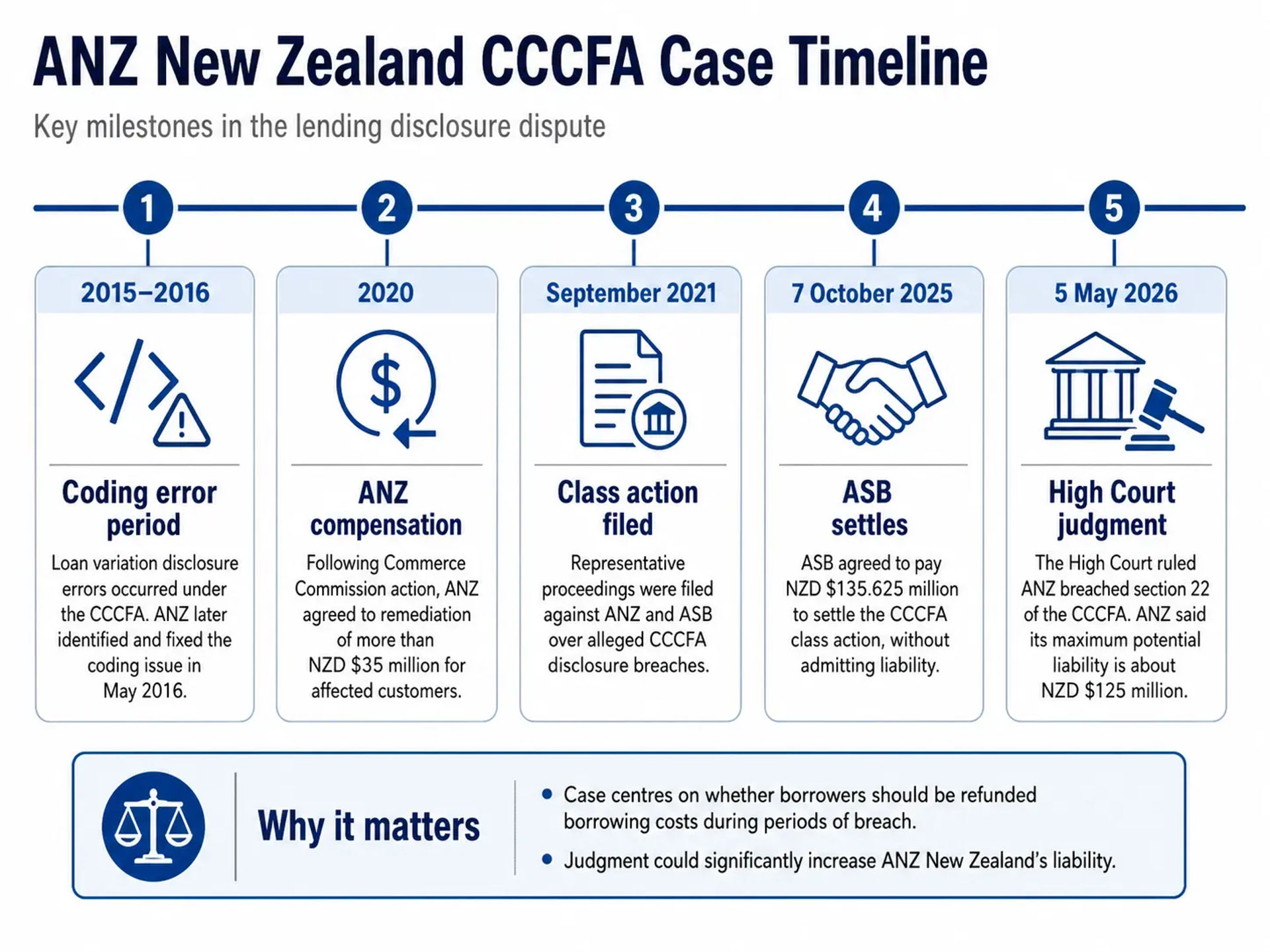
Under the High Court ruling, the representative plaintiffs in the case were found not liable for the cost of borrowing during the period of the breach. The court has directed ANZ New Zealand to refund these representative plaintiffs a total of $32,728.42. This specific finding sets the stage for the wider group of 17,000 customers to seek similar remediation, leading to the estimated $125 million total liability figure.
This judgment follows a complex history of remediation and litigation. The issue was first identified by the bank and reported to the Commerce Commission, with customers being informed of the coding error in mid-2018. In 2020, ANZ New Zealand reached a settlement with the Commerce Commission and paid $35 million in compensation to over 100,000 customers. However, the class action, filed in September 2021, argued that the bank’s legal obligations under the CCCFA required the full refund of interest and fees charged during the period of non-compliance, rather than the smaller amounts previously settled.
ANZ New Zealand Chief Executive Antonia Watson expressed disappointment with the High Court’s decision. The bank has maintained that the error was technical in nature and resulted in an average monthly underpayment of only $2 per affected customer. Watson stated that the bank is currently considering an appeal, suggesting that the interpretation of the law by the plaintiffs is disproportionate to the actual harm caused and does not align with the original intent of the CCCFA legislation.

The ruling against ANZ New Zealand comes months after a similar case involving ASB Bank reached a different conclusion. ASB Bank, which was initially part of the same class action filing in 2021, opted to settle its portion of the case in October 2025. ASB agreed to a settlement of $135.6 million without admitting liability. Prior to that settlement, ASB had already paid $8.1 million to 73,000 customers following its own disclosure failures between 6 June 2015 and 18 June 2019.

Related Articles


Comments
0Loading...
No comments yet. Be the first to share your thoughts.
