
Air New Zealand Faces Structural Headwinds as Fuel Volatility and Operational Costs Erase Profits
Air New Zealand (AIR.NZ) enters the second quarter of 2026 navigating a period of intense operational and financial turbulence. As of May 10, 2026, the national carrier's share price sits at 0.43, reflecting a significant year-to-date decline of -23.59%. The airline, which serves as a critical infrastructure pillar for New Zealand, has been forced to suspend its earnings guidance for the fiscal year ending June 30, 2026, citing unprecedented volatility in global jet fuel markets. This decision follows a sharp escalation in energy costs driven by geopolitical tensions in the Middle East, which has seen jet fuel prices nearly double, fundamentally altering the company's short-term profitability profile. With a market capitalisation of approximately NZ$1.37 billion, the organisation is currently grappling with the dual challenge of rising input costs and a weakening macroeconomic environment that threatens to dampen passenger demand.

Company Overview
Air New Zealand (AIR.NZ) operates as the flag carrier of New Zealand, maintaining a dominant position in the domestic aviation market while providing essential international links across the Pacific Rim. The New Zealand government remains the majority shareholder, a factor that provides a level of sovereign backing but also subjects the airline to high levels of public and regulatory scrutiny. The company's operations are diversified across domestic, regional, and long-haul international passenger services, complemented by a robust cargo division and an engineering and ground handling arm. Its strategic focus on the Pacific Rim, including key hubs in Australia, Asia, and North America, makes it highly sensitive to regional economic shifts and global trade flows. Despite its market-leading position within New Zealand, the airline remains vulnerable to external shocks, particularly those affecting the aviation supply chain and global energy prices.
Financial Metrics
For the first half of the 2026 financial year, ending December 2025, Air New Zealand reported a loss before taxation of NZ$59 million and a net loss after taxation of NZ$40 million. This performance represents a stark reversal from the full 2025 financial year, where the company achieved earnings before taxation of $189 million and a net profit after taxation of $126 million on revenues of $6.35 billion. The trailing twelve-month (TTM) Price-to-Earnings (P/E) ratio as of April 2026 stood at -51.40, reflecting the current lack of earnings.
The company's balance sheet shows a debt-to-equity ratio of approximately 1.55 as of December 2025, with NZD 2.84B in debt against NZD 1.83B in equity. While the airline maintained an annual dividend yield of 5.88% as of May 5, 2026, based on an annual dividend of 0.025 NZD, the sustainability of such distributions is under scrutiny given the forecast for potential pre-tax losses in both the 2026 and 2027 financial years. The stock's 52-week range highlights the recent volatility, with a high of 0.63 recorded on November 18, 2025, and a low of 0.41 reached on March 23, 2026.
Recent Catalysts
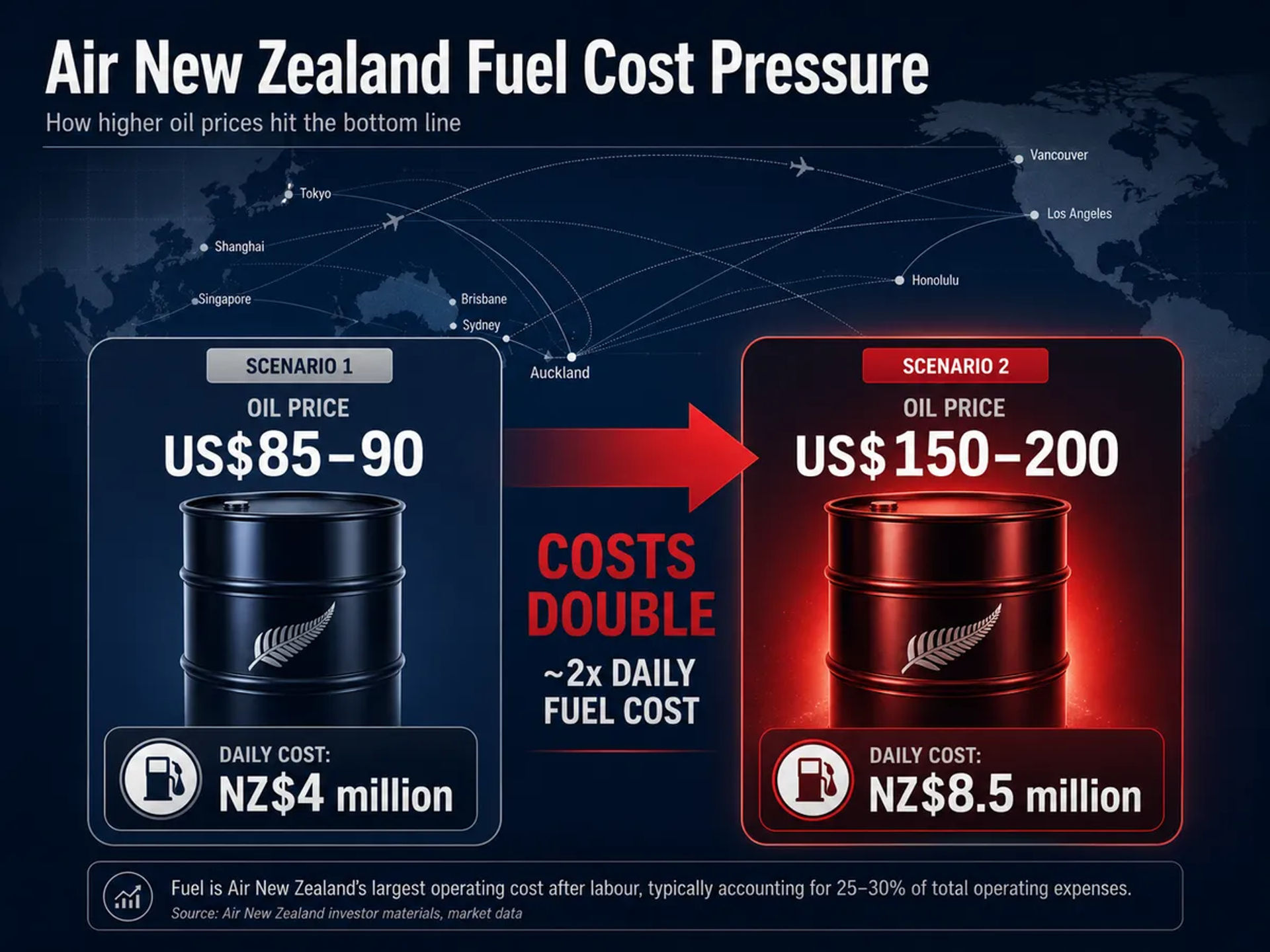
The primary catalyst for the recent downward pressure on Air New Zealand's valuation is the dramatic surge in jet fuel prices. Between late 2025 and March 2026, prices climbed from approximately US$85-90 per barrel to between US$150-200 per barrel. This spike effectively doubled the airline's daily fuel expenditure from NZ$4 million to NZ$8.5 million. Although the airline is 83% hedged against Brent crude for the second half of the 2026 financial year, it remains exposed to the jet fuel refining margin, known as the crack spread, which has widened significantly.
In response to these cost pressures, Air New Zealand implemented fare adjustments, including increases of $10 for domestic flights, $20 for short-haul international, and $90 for long-haul routes. Furthermore, the company announced schedule changes for May and June 2026, impacting approximately 4% of its flight programme. These adjustments are intended to optimise the network in the face of rising costs, but they also reflect the operational constraints currently facing the carrier. On May 8, 2026, the stock experienced a 3.4% drop in a single session, underscoring investor anxiety regarding these escalating energy costs and their impact on the broader aviation sector.
Technical Analysis
The technical outlook for Air New Zealand (AIR.NZ) remains bearish, with the share price currently trading at 0.43. This price point is situated below both the 50-day SMA of 0.46 and the 200-day SMA of 0.56, a configuration that typically signals a sustained downward trend. The 20-day EMA of 0.44 also acts as a near-term resistance level that the stock has struggled to overcome during recent sessions.
The RSI (14) is currently recorded at 41.88, which is considered neutral. This suggests that while the stock has seen significant selling pressure, it has not yet reached oversold conditions that might trigger a technical rebound.
Interestingly, the MACD is currently showing a bullish signal, with the MACD line positioned above the signal line. This divergence between the bearish moving averages and the bullish MACD suggests that the rate of the price decline may be slowing, even if a full trend reversal has yet to materialise. Over the past week, the stock has managed a modest return of +2.38%, though this follows a one-month decline of -3.37%.
Analyst Sentiment
Analyst consensus for Air New Zealand is predominantly negative, with a collective 'Sell' rating derived from 11 professional assessments. The current breakdown includes 1 strong sell, 7 sell, and 3 hold recommendations. There are currently no buy or strong buy ratings for the stock. This represents a significant shift in sentiment from earlier in the year when the majority of analysts held a 'Hold' position.

In March 2026, analysts at Jarden downgraded the stock to 'sell' and reduced their 12-month target price to 0.47 NZD. The average 12-month price target across all analysts is 0.46 NZD, which implies a narrow upside of 2.39% from the current price of 0.43. Individual price targets show a wide dispersion, ranging from a low of 0.35 NZD to a high of 0.63 NZD, reflecting differing views on how long the current fuel and operational headwinds will persist.
Risks and Outlook
Several critical risks continue to cloud the outlook for Air New Zealand. Beyond the immediate impact of fuel price volatility, the airline is facing ongoing engine maintenance issues that have constrained fleet availability and forced schedule adjustments. These technical challenges are compounded by a weak macroeconomic environment in New Zealand and key international markets, which could lead to a reduction in discretionary travel spending.
Increasing competition on international routes, particularly across the Pacific, poses a threat to the airline's yield management. Rising operational costs, including labour and airport charges, are also compressing margins. Analysts forecast that these factors could lead to continued pre-tax losses through the 2027 financial year. While the airline's dominant domestic position provides a level of stability, the high debt-to-equity ratio of 1.55 limits the company's financial flexibility to navigate a prolonged downturn without potentially requiring further capital management strategies.
Air New Zealand remains in a defensive posture as it manages the most significant fuel price shock in recent years. While the +2.38% return over the last week provides a momentary pause in the downward trajectory, the broader technical and fundamental indicators remain challenged. The stock's position below its and the prevailing 'Sell' consensus among analysts suggest that investors remain cautious. The airline's ability to successfully pass on increased costs to consumers through fare hikes, without significantly impacting load factors, will be the critical metric to monitor in the coming months.
Related Articles


Comments
0Loading...
No comments yet. Be the first to share your thoughts.
