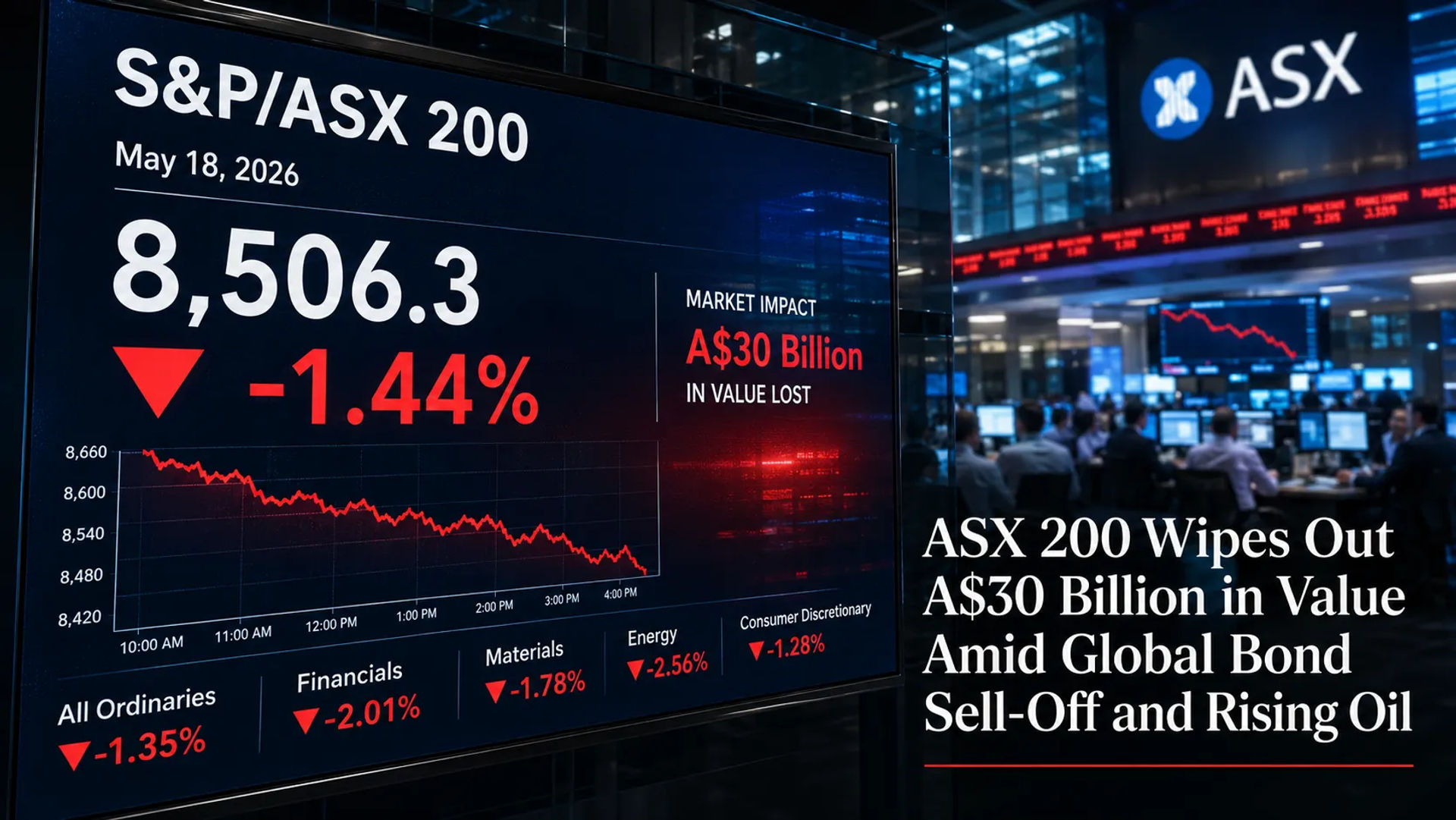
ASX 200 Wipes Out A$30 Billion in Value Amid Global Bond Sell-Off and Rising Oil
Australian equity markets suffered a sharp contraction on Monday, May 18, 2026, as a combination of surging energy costs and a global retreat from bond markets triggered a broad-based sell-off. The benchmark S&P/ASX 200 Index fell by 1.44%, or 124.5 points, to close at 8,506.3 points. This decline represented a loss of more than A$30 billion in total market value, reflecting heightened investor anxiety regarding persistent inflationary pressures and the trajectory of international interest rates.
The broader All Ordinaries Index mirrored the downward trend, declining by 1.38% to finish the session at 8,312.7 points. Market sentiment was heavily influenced by developments in the global bond market, where yields rose sharply, and a significant spike in oil prices. Brent Crude oil climbed 1.83% during the day to reach US$111.25 per barrel, surpassing the psychologically significant US$110 threshold. This move in energy markets has intensified concerns that the Reserve Bank of Australia (RBA) may need to maintain restrictive policy settings for a longer period than previously anticipated.

Sector Performance and Corporate Movements
The downturn was felt across almost every corner of the ASX, with all 11 primary sectors finishing in negative territory. The mining and banking sectors, which carry significant weight in the index, led the decline. BHP Group and the major financial institutions, including CBA, ANZ, and Westpac, faced selling pressure as investors recalibrated their expectations for economic growth amidst rising yields. The Australian dollar also showed signs of weakness in this "risk-off" environment, trading at 71.27 US cents by the market close, down from 71.59 US cents on the preceding Friday.
A notable outlier in the corporate landscape was Brambles Ltd, which saw its share price plummet 14.4%. This sharp correction followed an announcement from the logistics organisation downgrading its earnings guidance for the 2026 fiscal year. In contrast, the energy sector provided the only source of relative strength, buoyed by the rising price of crude. Woodside Energy Group Ltd recorded a share price increase of 2.2%, while Santos Ltd rose by 1.9%. Other energy-related entities, such as New Hope Corporation Ltd, also navigated the volatility more effectively than the broader market as energy security concerns remained at the forefront of investor minds.

Inflationary Pressures and Monetary Policy
The market's reaction on May 18, 2026, follows a period of sustained concern regarding the RBA and its efforts to contain rising prices. On May 5, 2026, the RBA Board increased the RBA Cash Rate to 4.35%, following a previous hike to 4.10% on March 17, 2026. This tightening cycle is occurring against a backdrop of challenging economic data, with the Australian Treasury projecting Australia CPI inflation to reach 5% for the 2025/26 period.
Related Articles

Comments
0Loading...
No comments yet. Be the first to share your thoughts.

