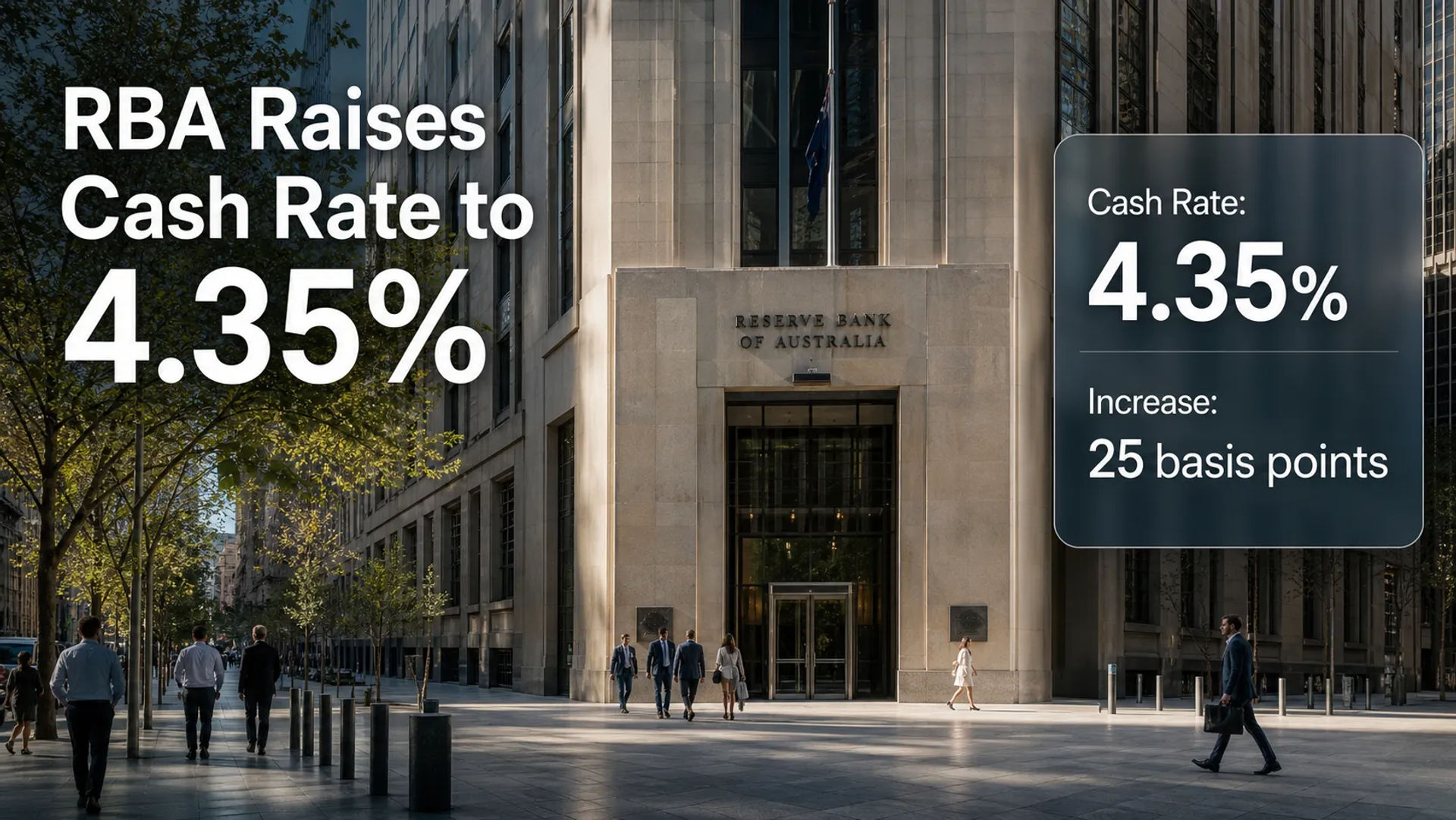
Reserve Bank of Australia lifts cash rate to 4.35 per cent in third consecutive hike
The Reserve Bank of Australia (RBA) has increased the cash rate target by 25 basis points to 4.35 per cent during its board meeting on May 5, 2026. This decision marks the third consecutive monthly increase in the current tightening cycle, following previous adjustments in February 2026 and March 2026. The move effectively reverses the cycle of monetary easing implemented throughout 2025, as the central bank intensifies its efforts to return inflation to its 2-3 per cent target range.

The decision to raise the rate from 4.1 per cent to 4.35 per cent was driven by data indicating that inflation remains stubbornly high. Headline CPI was recorded at 4.6 per cent in March 2026, while the trimmed mean CPI, a key measure of underlying inflation, stood at 3.3 per cent. These figures suggest that price pressures are more persistent than previously anticipated, necessitating a more restrictive monetary policy stance.
A significant factor contributing to the elevated inflation environment is the ongoing conflict in the Middle East. This geopolitical instability has led to a sharp rise in global oil and fuel prices, which has directly impacted the Australian economy. The RBA noted that these energy costs have a broad effect on the prices of goods and services, contributing to an 8.9 per cent increase in specific transport and logistics components. This external pressure has complicated the task of bringing headline inflation back within the desired band.

Domestic economic conditions also played a critical role in the May 5 decision. Australia's labour market has shown remarkable resilience despite the series of rate hikes earlier this year. The unemployment rate held steady at 4.3 per cent in March 2026, indicating that demand for labour remains robust. While high employment is generally positive for the economy, the RBA views the current tightness in the labour market as a factor that could sustain domestic inflationary pressures through wage growth and services costs.
The RBA Board was not unanimous in its decision to raise the cash rate. The final outcome was reached by a majority vote, with eight members opting for the 25 basis point increase, while one member voted to hold the rate steady at 4.1 per cent. This internal divergence reflects the complex balancing act the board faces as it navigates what some economists describe as uncharted territory, with interest rates now exceeding the peaks seen in 2024.
Updated forecasts released alongside the decision suggest that underlying inflation will peak higher and take longer to return to the 2-3 per cent target than the RBA had previously modelled. The central bank now expects the path back to price stability to be more protracted, citing materially heightened uncertainties in both the global and domestic outlooks. This revised timeline implies that the period of high interest rates may persist for longer than households and businesses had hoped.
For Australian mortgage holders, the cumulative impact of the 2026 tightening cycle is becoming increasingly significant. For a household with a $600,000 mortgage, the 25 basis point hike on May 5 adds approximately $91 to monthly repayments. When combined with the increases delivered in February and March, the total monthly repayment for such a loan has risen by $272 since the start of the year. This rapid increase in debt-servicing costs is expected to further constrain household discretionary spending in the coming months.
Related Articles
Comments
0Loading...
No comments yet. Be the first to share your thoughts.

